How to Design a Pool for a Sloped or Rocky Hill Country Lot
A hillside lot is harder to build on, and it also makes room for the most dramatic pools, if the engineering is done right.
October 14, 2026 · 4 min read
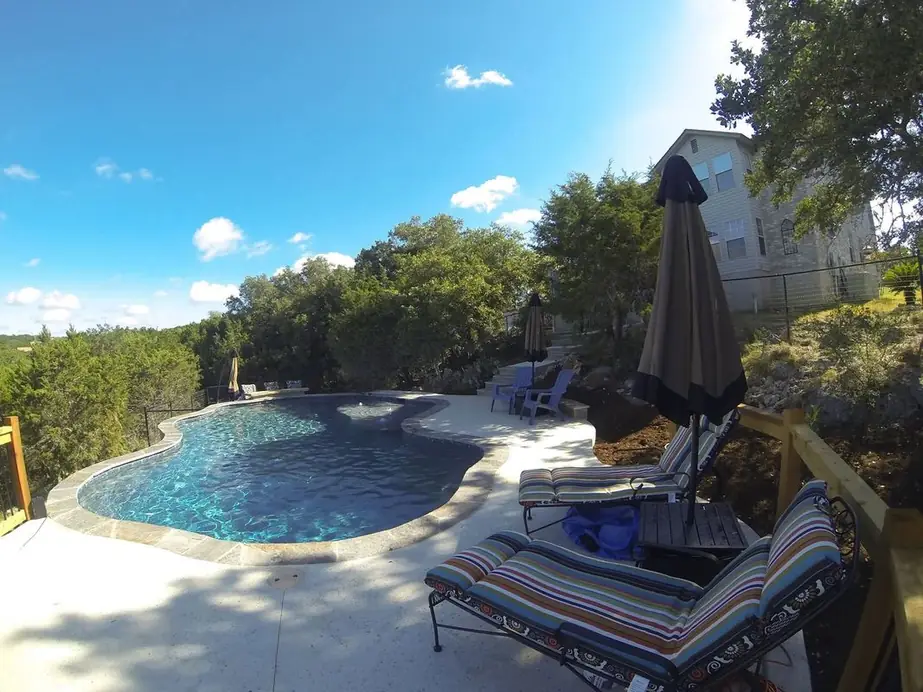
If you own a hillside lot in the Texas Hill Country, you've probably heard at least one contractor call it a tough one. They're not wrong. Sloped and rocky ground adds real complexity to a pool build. It also produces some of the best backyard setups we've ever built, and the difference comes down to knowing what you're working with before anyone starts drawing.
Most Hill Country lots aren't flat
Lots in this part of Texas come with grade changes, outcroppings, caliche layers and limestone shelves that never show up on a property survey. Pools Unlimited has been building on this ground since 2000, and hillside work is the majority of what we do. Four conditions drive the complexity, and each one needs a plan before you sign anything.
- Limestone and caliche. Hard rock doesn't stop a gunite build. It takes the right equipment and more excavation time, and we blast or break through limestone regularly. The upside is that a hard substrate makes for a very stable pool shell over the long run.
- Grade changes. On a real slope the pool is cut into the hillside on one side and built up on the other. That's where retaining walls come in, and we engineer them in-house as part of the pool structure, not as an afterthought.
- Drainage. Water has to go somewhere. Poor drainage around a hillside pool leads to erosion, deck heaving and long-term structural trouble, so we handle drainage engineering in-house on every build.
- Access. Tight lots, steep driveways and narrow side yards limit which equipment can reach the site. We check access on the first visit, because it changes both the construction approach and the schedule.
Why gunite suits this ground
Gunite is concrete sprayed over a steel reinforcing cage, which means the shell is formed on site rather than delivered as a finished shape. That matters on a hillside, where the pool rarely sits on a clean rectangle of level ground. A shell built in place can follow the contours, step down with the grade and tie into the retaining walls instead of fighting them.
Sloped lots make the best-looking pools
Here's what many contractors skip over: elevation change is where the most dramatic designs happen. A flat yard simply can't do what a slope can. With a hillside you can build any of these.
- Infinity edges that appear to disappear into a Hill Country view.
- Raised bond beams that make a visual statement from inside the house.
- Multi-level designs where the spa sits above the pool and spills down into it.
- Natural rock features built right into the pool structure.
Infinity edges can technically be built on flat lots with a raised bond beam, but a slope is where they make the most visual sense. When the downhill wall drops into a view, the effect is something a level yard can't copy. If your lot looks like a problem, it may be an opportunity, and a walk of the property is the quickest way to find out which.
Three approaches that work on hillsides
- Cut and fill. We cut into the uphill side and use that material to build up the downhill side, which gives the pool a level pad. It's simple and cost-effective, and it suits moderate grades because it avoids large retaining walls.
- Raised bond beam. On steeper grades the downhill wall of the pool becomes a raised structure, sometimes 4 to 6 feet tall. That creates a natural spot for a vanishing edge or a waterfall on the downhill face.
- Multi-level terracing. On larger lots with big grade changes, we sometimes terrace the whole yard, with the pool on one level and the outdoor living space on another, linked by steps or a path. If you're picturing a patio or outdoor kitchen next to the water, this one is worth exploring.
Timeline and budget on a difficult lot
Be honest with yourself about two things going in. Sloped and rocky lots take longer and cost more than flat ones, and that isn't a contractor upsell. It's physics. Excavation on rocky terrain can add 1 to 3 weeks to a build. Retaining walls add material and labor. Engineering and permitting for a hillside pool are more involved than for a standard residential permit.
On cost, the figures we publish are $8,000 to $25,000 extra for excavating through limestone, and $15,000 to $40,000 extra for a sloped lot that needs retaining walls and more complex forming. Those are ranges, not quotes. Two lots on the same road can land at opposite ends, which is why we don't give numbers without seeing the ground.
Can any pool contractor build on rock?
Not well. Rocky terrain calls for specialized equipment, blasting or breaking through limestone, and engineering for retaining walls and drainage that can't be improvised. Plenty of builders look at a hillside lot and either walk away or underbid it and cut corners later. Ask any contractor you're considering who does the retaining wall engineering and who handles drainage. At Pools Unlimited both happen in-house, and it's standard on every hillside build rather than an add-on.
The premium for a well-executed hillside pool is real, and so is the result. We build under a fixed-price contract, so you'll know the full number before we break ground and won't meet surprises halfway through.
The only way to understand what your lot needs is to stand in the backyard and look at it. The on-site visit is free, with no pitch. Call Pools Unlimited at (830) 980-5051 and we'll walk the property together.
Pools Unlimited, Inc., (830) 980-5051
Call (830) 980-5051More articles
How Much Does a Gunite Pool Cost in the Texas Hill Country?
A straight answer on what a custom gunite pool costs here, and why the same pool can land at very different numbers on two different lots.
Signs Your Pool Needs Resurfacing or a Remodel
Most pools don't need to be torn out. They need an honest look at what's actually worn, and a plan to fix only that.